

Below, please find the latest issue of The Spiritual Watch, the official publication of the Metropolis of America, published with the blessings of His Eminence, Metropolitan Demetrius of America. In The Spiritual Watch, you will find news and information regarding our Holy Metropolis, as well as spiritual writings.
The Spiritual Watch, Vol VII (New: February 24/March 8, 2024)
[Abba Moses said:] 'Fasts and vigils, the study of Scripture, renouncing possessions and everything wordly are not in themselves perfection, as we have said; they are its tools. For perfection is not to be found in them; it is acquired through them. It is useless, therefore, to boast of our fasting, vigils, poverty, and reading of Scripture when we have not achieved the love of God and our fellow man. Whoever has achieved love has God within himself and his intellect is always with God.'
—St. John Cassian, On the Holy Fathers of Sketis.
The Pentecostarion is the period of the ecclesiastical year from Pascha to Pentecost.
Having just been prepared through the Triodion, the Great Fast and Holy Week we celebrate the Feast of feasts and Festival of festivals, the Resurrection of Christ. It is through the church services that we noetically relive the events in the Gospel and the life of Christ becomes our own life, for it is not we who live but Christ who lives in us.
Continuing the spirit of Holy Week, where the ecclesiastical commemoration of the events surrounding the Passion of Christ followed in chronological order, the Church celebrates the Apostle Thomas's touching the Resurrected Body of Christ on the eighth day of Pascha, on the fortieth day of Pascha we celebrate His Ascension into the Heavens and on the fiftieth day we celebrate Pentecost.
From Pascha till Pentecost we read from the Gospel according to St. John the Theologian. This telling of the Gospel differs from the other three synoptic Gospels in that it focuses on Christs Divinity. The synoptic Gospels were used during catechism and the Gospel according to St. John was reserved for the enlightened after baptism. Great and Holy Saturday was the day on which the catechumens were baptized so it is on Pascha that we begin to read from the Gospel according to St. John.
The fourth, fifth, and sixth weeks of Pascha emphasize Christ's divinity though His unprecedented preaching to the Jews and the healings performed in the Temple of Solomon during the Jewish feasts, and His revelation to St. Photeine, the Samaritan woman that He is the Messiah.
The Sunday in-between the Ascension and Pentecost is dedicated to the Fathers of the 1st Ecumenical Council in Nicaea. When speaking of His Ascension, Christ promised not to leave us orphans but that He would be with us, even until the end of time. It is through His Church (against which the gates of Hades shall not prevail) through the mystery of Apostolic Succession that He is with us.
At a bishop's ordination the hymns of Pentecost are chanted because the bishops are successors of the Apostles and the same Holy Spirit Who descended upon the Apostles also descends upon the ordinand. After the Leave-taking of Pentecost is the 1st Sunday of Matthew and having completed the Acts of the Apostles we continue with St. Paul's epistle to the Romans.
Although the Pentecostarion comes to an end and the ecclesiastical year continues, a connection is made between Pentecost and the continuing life of the Church. This connection is expressed in the commemoration All Saints from all ages and in all places, Prophets, Apostles, Hierarchs, Martyrs & Righteous. All of whom worship the Triadic God in Orthodox manner.
Truly their sound hath gone forth into all the earth, and their words unto the ends of the world for Christ is with us always even unto the end of time.
Ten days before his repose, His Beatitude the Archbishop asked a relative of his, Demetrios Grammatikos, to bring him by car to his village (Erythrai of Megara) as he said characteristically; “so that I can see it for the last time”. He went, and as he wandered around the streets of the village, he met some of his relatives.
He went to the monastery of St Meletios as he has does every year, since it was the feast of the saint according to the patristic calendar. While returning to his monastery of the Most-Immaculate Virgin in Megara he visited the monastery of the Theotokos “Quick to Hear” in Oinoe.
The same day he was diagnosed with heart trouble by his cardiologist.
Accompanied by Fr. Cyril and a nun, he traveled to a coastal region of Megara where they planned to baptize a woman catechumen; so that they could see if the place was appropriate. Returning to the monastery he said, “My children, my strength is failing me and my end is near. Glory be to God, I lived many years. The only thing I ask is that I have a good end and that God grant me a good defense before His terrible judgment seat.”
Back at the monastery he said the following which was recorded by a nun:
“My children, you must have fortitude. Whatever happens in your lives, you should confront it with fortitude. Even in the way you handle my situation you must show fortitude, if you believe that we will meet again.
God will see your fortitude and will grant you paradise.
I sit and think how all the saints had a martyric death. The crown of sanctity, the Great Forerunner, how his holy head was cut off by an adulteress. But what can I say? Since God permitted His beloved, only-begotten Son to be crucified; what can we say?”
He went to the baptism of the catechumen at the coastal region of Megara which they had chosen the previous day. He did not take part in the baptism but he went in order to witness this joyous event and it was there that he felt his health diminish greatly. When he returned to the monastery he gave directions on the preparations for the upcoming feast of the monastery; the Nativity of the Theotokos, and said:
“Don’t put many little flags, just the three big ones. Don’t make a meal and other preparations.”
The nuns said “But we have prepared everything already, Geronda.”
“Oh well…” he answered.
He called the Secretary of the Holy Synod; Bishop Photios of Marathon, on the telephone and told him: “My child, inform the Bishops that the Synod will take place in the Synodal offices (in Athens) and not here (in the monastery of the Most-Immaculate Virgin in Megara; a regular Synod meeting had been scheduled for Thursday September 10/23). I won’t be able to be there, I am very weak.”
After examining him, his cardiologist informed the sisterhood of the monastery that the Archbishop was not well. He then asked them “Do you want us to take him to the hospital or leave him here at the monastery? In any event, the hospital will not offer him anything more than what is here.”
A baker named Prokopios told the Archbishop in a telephone conversation “Your Beatitude, I will not be able to bring the breads and the sweets for the feast day on Monday afternoon; I’ll bring them Sunday afternoon.” The Archbishop answered him, “When you come, will I be here?”
Again he said to one Constantine Maziotes; a friend of the monastery: “Constantine, don’t put many little flags, just the three big ones, I’m going to die.”
In the morning he attended the Divine Liturgy at the monastery and received the Immaculate Mysteries.
He told Metropolitan Chrysostomos of Attica and Boitia and Bishop Photios of Marathon, who had come to visit him that evening, “You will have to preside over the monastery’s feast by yourselves. If I’m here (meaning in his cell), I will hear you.”
He couldn’t get up out of bed. He heard the service through the speakers which are throughout the monastery.
After the psalter readings of matins, one of the sisters went and asked him, “How are you, Geronda?”
He answered, “I’m having a little difficulty breathing.”
He held an icon of the Theotokos to his chest and continually prayed. Crying, the nun asked the doctor to come. Before the doctor came he asked for the icon of Christ from the neighboring chapel of the Angels, which they brought to him. He kissed it, prayed and told them to bring it back to the chapel. He continued to pray and after a short while he again asked them to bring him the same icon. Again he kissed it and prayed and told them to place the icon next to him.
It was the first time that he did not stand up for the Gospel reading and the Cherubic Hymn during the liturgy. The cardiologist came shortly before the end of the Divine Liturgy and she tried to help him. It so happened that there where three other doctors next to him who were at the monastery and who insisted that they take him to the hospital. Then his breathing became heavy. The nuns, who in the mean time had gathered around him, when they saw that he was having difficulty breathing, went into the chapel to chant the Supplicatory Canon to the Theotokos “Quick to Hear” and as they did, his difficulty breathing stopped immediately. Since the doctors were insisting on taking him to the hospital, one nun asked him, “Geronda, the doctors are insisting that we go to the hospital.” And his answer was, “no.” In the past he had never refused to be taken to the hospital when there was need.
All of the nuns of the monastery were kneeling around him. The Archbishop was praying with his hands crossed over his chest and holding the icon of the Theotokos. He started to say the 50th Psalm “Have mercy on me, O God, according to Thy great mercy…” but after the first two verses he could not continue so he asked one nun to continue while at the same time he told one nun to say the prayer “Lord, Jesus Christ, have mercy on Thy servant.” After a short while he took three small breaths, closed his eyes and gave his soul into the hands of the living God.
This is the righteous end of His Beatitude, Archbishop Chrysostomos II. It was 1:30 p.m. on September 6/19, 2010, exactly 55 years after the repose of his blessed predecessor Chrysostomos I who reposed on the night between September 6th & 7th, 1955. Both of their funeral services were held on the feast of the Nativity of the Theotokos; which feast His Beatitude loved very much and dedicated the monastery which he founded in its honor.
He always used to say: “Four things I want our Lord: That I may end this life upright, that God may allow me to keep my wits, that I have my voice until the end so that I may I may continue to hymn Him and that I not bury one of my spiritual children.” God—finally—fulfilled these four wishes of his. During the last liturgy which he presided over on the feast of St. John Chrysostomos in 2009 in the monastery of the Most-Immaculate Virgin in Megara, among the last words of his homily were: “May the grace of God deem us worthy of a good end. Beloved, this is my greatest wish: A GOOD END.” Truly, God deemed him worthy of a good end.
May his prayers be with us.
Translated from the GreekThe Church of the Genuine Orthodox Christians (GOC) of America is The Traditionalist Orthodox Church serving the faithful of North and South America following the old (Julian) calendar. Having its roots in the Diocese of Astoria, founded by Metropolitan Petros (Astyfides) in 1954, it presently consists of two Metropolises (America and Toronto) and two dioceses (Etna and Portland, and Boston), shepherded by five hierarchs, under the Presidency of His Eminence, Metropolitan Demetrius of America.
The Church of the GOC of America is an autonomous Eparchy whose Mother Church is The Holy Synod of the Church of the GOC of Greece, under the Presidency of His Beatitude Archbishop Kallinikos of Athens and All Greece. The bishops belonging to the Eparchial Synod are also members of the Holy Synod of the Church of Greece. We resist the heresy of Ecumenism.


“Trust ye not in princes, in the sons of men, in whom there is no salvation.”
(Psalm 145:3)
We mustn’t have absolute trust in human beings for our salvation, no matter what dignity they have. Human beings are changeable. Today they are saints, tomorrow—deniers. Today—sinners, tomorrow—righteous. We must have absolute trust in God, and in Him we must base our hopes of salvation. “Blessed is he of whom the God of Jacob is his help, whose hope is in the Lord his God” (Psalm 145:5). Read more...
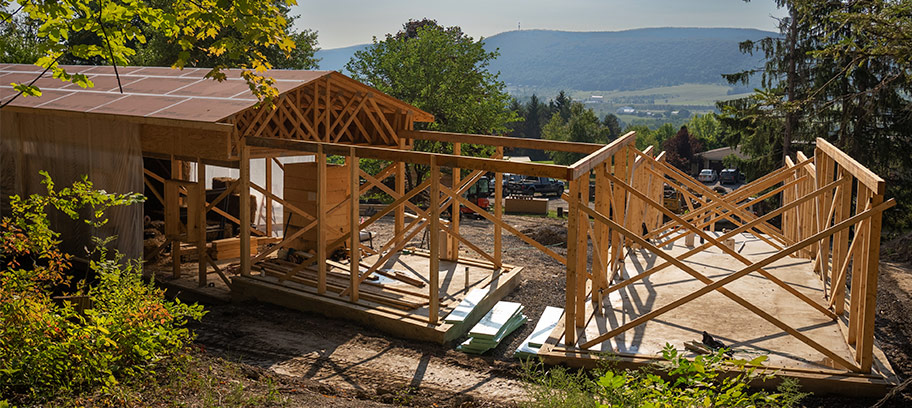
Saints Peter and Paul Orthodox Church is a beautiful mission parish near downtown Tucson, a city in southern Arizona. It was started in 1997 by Father John Bockman, who was a missionary Priest formerly serving missions in Tennessee and Massachusetts since 1990. Father John served the faithful in Tucson and the surrounding area in his home Chapel until his repose in November of 2000. His wife, Presbytera Valerie, continued to make her home Chapel available for the mission, with clergy from Saint Nectarios Orthodox Church in Seattle and His Eminence, Metropolitan Moses of Toronto (then of Portland), visiting to provide the Divine Services.
Read more...2026 Youth Conference
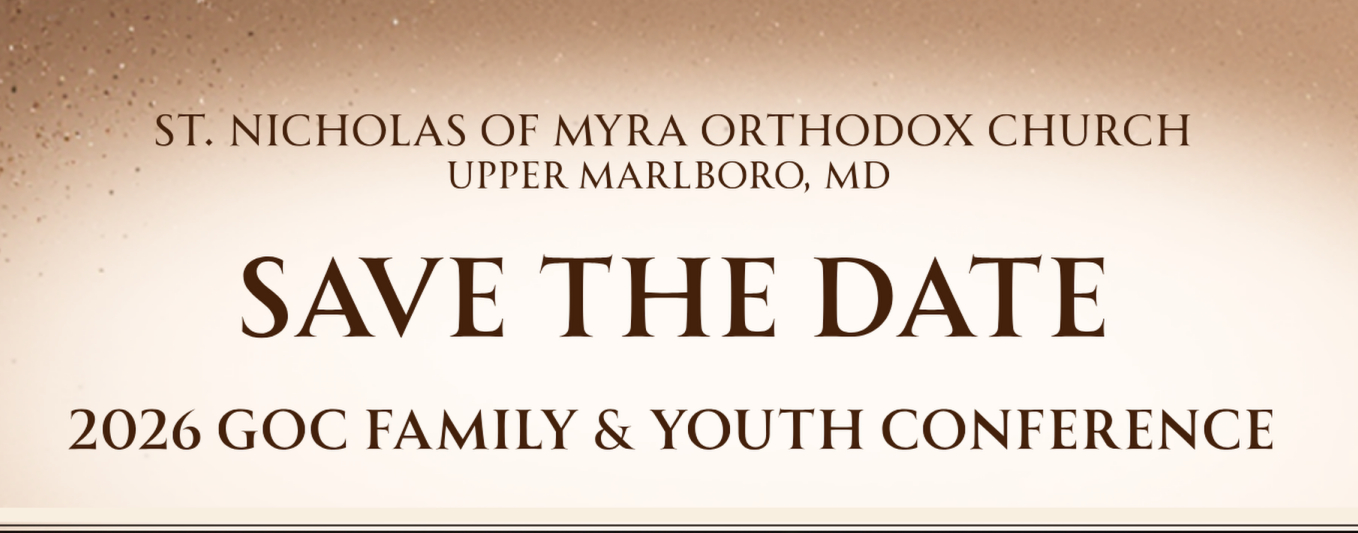
Please join us for the 2026 youth conference in Upper Marlboro, MD! To learn more, visit the this page.
Q. I noticed that we call the angels Michael and Gabriel "Saint." I thought the title "Saint" was only given to humans who have proven themselves Godly. Do you mind clarifying this for me? Is there a deeper meaning to "Saint" that I am not aware of?
-S.L. Read more...
© 2026 Church of the Genuine Orthodox Christians of America (GOC). All Rights Reserved.
For inquiries, please contact the webmaster.