

Below, please find the latest issue of The Spiritual Watch, the official publication of the Metropolis of America, published with the blessings of His Eminence, Metropolitan Demetrius of America. In The Spiritual Watch, you will find news and information regarding our Holy Metropolis, as well as spiritual writings.
The Spiritual Watch, Vol VII (New: February 24/March 8, 2024)
[Abba Moses said:] 'Fasts and vigils, the study of Scripture, renouncing possessions and everything wordly are not in themselves perfection, as we have said; they are its tools. For perfection is not to be found in them; it is acquired through them. It is useless, therefore, to boast of our fasting, vigils, poverty, and reading of Scripture when we have not achieved the love of God and our fellow man. Whoever has achieved love has God within himself and his intellect is always with God.'
—St. John Cassian, On the Holy Fathers of Sketis.
The Pentecostarion is the period of the ecclesiastical year from Pascha to Pentecost.
Having just been prepared through the Triodion, the Great Fast and Holy Week we celebrate the Feast of feasts and Festival of festivals, the Resurrection of Christ. It is through the church services that we noetically relive the events in the Gospel and the life of Christ becomes our own life, for it is not we who live but Christ who lives in us.
Continuing the spirit of Holy Week, where the ecclesiastical commemoration of the events surrounding the Passion of Christ followed in chronological order, the Church celebrates the Apostle Thomas's touching the Resurrected Body of Christ on the eighth day of Pascha, on the fortieth day of Pascha we celebrate His Ascension into the Heavens and on the fiftieth day we celebrate Pentecost.
From Pascha till Pentecost we read from the Gospel according to St. John the Theologian. This telling of the Gospel differs from the other three synoptic Gospels in that it focuses on Christs Divinity. The synoptic Gospels were used during catechism and the Gospel according to St. John was reserved for the enlightened after baptism. Great and Holy Saturday was the day on which the catechumens were baptized so it is on Pascha that we begin to read from the Gospel according to St. John.
The fourth, fifth, and sixth weeks of Pascha emphasize Christ's divinity though His unprecedented preaching to the Jews and the healings performed in the Temple of Solomon during the Jewish feasts, and His revelation to St. Photeine, the Samaritan woman that He is the Messiah.
The Sunday in-between the Ascension and Pentecost is dedicated to the Fathers of the 1st Ecumenical Council in Nicaea. When speaking of His Ascension, Christ promised not to leave us orphans but that He would be with us, even until the end of time. It is through His Church (against which the gates of Hades shall not prevail) through the mystery of Apostolic Succession that He is with us.
At a bishop's ordination the hymns of Pentecost are chanted because the bishops are successors of the Apostles and the same Holy Spirit Who descended upon the Apostles also descends upon the ordinand. After the Leave-taking of Pentecost is the 1st Sunday of Matthew and having completed the Acts of the Apostles we continue with St. Paul's epistle to the Romans.
Although the Pentecostarion comes to an end and the ecclesiastical year continues, a connection is made between Pentecost and the continuing life of the Church. This connection is expressed in the commemoration All Saints from all ages and in all places, Prophets, Apostles, Hierarchs, Martyrs & Righteous. All of whom worship the Triadic God in Orthodox manner.
Truly their sound hath gone forth into all the earth, and their words unto the ends of the world for Christ is with us always even unto the end of time.
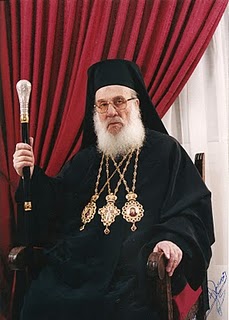
His Beatitude Archbishop Chrysostomos II of Athens and First-Hierarch of the Genuine Orthodox Church of Greece was born on 8 October 1920 in Erythrai (Kriekouki) of Megara, where he grew up as a young boy. Later he lived with his parents in the town of Lavrion in the province of Attica. While a student, he would frequent many churches and monasteries, growing fond of Byzantine music. Frequently, during the great holidays of the Orthodox calendar, he would travel from Lavrion to Erythrai in order to chant at his village’s church where the Genuine Orthodox would congregate to celebrate the divine services (typically without the presence of a priest, for they were small in number in comparison to the needs of the parishes). He completed his secondary education at the age of 17.
Fulfilling his father’s wish, he took the entrance examinations for the Evelpidōn Military Academy, planning to embark on a career in the military. However, he was afflicted by illness on account of which he abandoned the idea of a military career. He considered the illness a divine intervention that led to his enlistment in the army of the heavenly king and to the path of monasticism. That was the desire of his spiritual father, Bishop Matthew of Vresthena. Subsequently, he dedicated his time to recuperating and private study at his home during the period that coincided with the Greco-Italian War of 1940-1941 as well as the German occupation of Greece of 1941-1944.
Right after the liberation of Greece, he was tonsured at the Monastery of the Annunciation in Athikia, near Corinth, by the Archimandrite Kallistos Makris, later the Metropolitan of Corinth. During the Greek Civil War (1944-1949), the monastery was caught in the fighting between the opposing the sides and he was miraculously saved from death. He was ordained to the priesthood in 1947 by Bishop Germanos of the Cyclades of blessed memory, briefly living in the country on account of his illness while serving the faithful of Erythrai and Villia. He was tonsured into the Great Schema at the Monastery of the Virgin Kosmosōteira in 1948 by the ever-memorable Elder Theokletos Darademas.
During the years 1951-1953, the New Calenderist Archbishop Spyridon Vlachos began a persecution of the Genuine Orthodox Christians. Our hierarchs were exiled. The churches were locked and our priests were captured and stripped of their cassocks, while being paraded and mocked by the police. On the eve of the Annunciation in 1951, the ever-memorable Bishop Germanos of the Cyclades reposed in the Lord. Spyridon Vlachos forbade his ecclesiastic burial and, showing himself to be a worthy successor of Caiaphas, he ordered that the body of the deceased be guarded by gendarmes at the Clinic of Saint Helen in the Athenian suburb of Sepolia (where he was transferred from jail while breathing his last) in order to prevent the reading of a burial service by a Genuine Orthodox priest. God, however, arranged otherwise. During the same period, the Archimandrite Chrysostomos Kiousis was secretly in hiding to avoid capture and stripping by the police, and celebrated the Divine Liturgy in country chapels and in the houses of faithful Christians that had been transformed into catacombs, moving about only at night with great caution. In March of 1951, in one of those catacombs, he celebrated the Vigil of the Annunciation of the Theotokos along with the ever-memorable Archmandrite Petros Astyfides (later, Bishop of Astoria), deeply grieved by the news of the passing of the ever-memorable Bishop Germanos. A white cloth with paper icons pinned to it separated the Holy Altar from the rest of the room. Two tables assumed the role of the Altar and the Table of Oblation. They celebrated the liturgy in this manner when suddenly at two o’clock in the morning there was a knocking on the door! Fortunately, it was not the police but rather members of N.E.O.S., the youth organization of the Genuine Orthodox Church, who were seeking a priest to secretly conduct a burial service, having convinced the gendarme guarding the body of Bishop Germanos to “look the other way.” While Fr. Petros continued the Vigil, Fr. Chrysostomos went to read the funeral of the reposed hierarch. As the funeral approached its end the gendarme, who was following the service piously, warned that the time had come for him to be relieved. As Fr. Chrysostomos and his entourage were heading for their car, the oncoming gendarmes spotted him. A chase ensued. However, Pericles, the priest’s experienced driver, drove through the maze of Athenian streets and managed to escape, thus keeping Fr. Chrysostomos from being captured and stripped.
In 1956, Fr. Chrysostomos assumed the responsibilities of the General Secretary of the Ecclesiastical Committee, which had assumed the leadership of our Church provisionally after the repose of the ever-memorable Metropolitan Chrysostomos of Florina, the First-Hierarch of the Church of the Genuine Orthodox Christian of Greece from 1943 to 1955. At the direction of the Ecclesiastical Committee, he traveled by train to Germany and France along with Fr. Akakios Pappas the Younger (the current Metropolitan of Attica and Diavlia) in order to establish contact with the Archbishop of the Russian Orthodox Church Outside of Russia (ROCOR) in Western Europe, St. John (Maximovich), with the goal of consecrating Bishops for the Genuine Orthodox Church of Greece. While agreeing to ordain clergy for the Genuine Orthodox of Greece, St. John referred them to Metropolitan Anastasy (Gribanovsky), the First-Hierarch of ROCOR from 1936 to 1965, regarding the question of episcopal ordinations. In 1957, Fr. Chrysostomos was chosen as a candidate for elevation to the episcopacy along with the priest-monks Akakios Pappas the Elder and Chrysostomos Naslimis by the Second Pan-Hellenic Clergy Conference of the Genuine Orthodox Church of Greece. He worked diligently for the consecration of the ever-memorable Archbishop Akakios Pappas the Elder and the restoration of the Greek episcopate by the ROCOR in 1960. After that, he founded the Monastery of the Most-Immaculate Virgin in Megara, serving the Church as secretary to the Synod.
On July 8, 1971 (o.s.) he was consecrated Metropolitan of Thessalonica, taking up additionally the pastorship of Eastern Macedonia and Thrace. As Metropolitan of Thessalonica he dedicated all his energies to the organization of his Diocese until January 16, 1986 (o.s.) when he was elected Archbishop of Athens and First-Hierarch of the Genuine Orthodox Church of Greece—the office which he held until 6 September 2010 (o.s.) when he reposed in the Lord after divine liturgy on the feast of the miracle of the Archangel Michael at Chonai.
It was during his pastorship that the Genuine Orthodox Church of Greece was formally recognized by the Hellenic Republic, providing a legal framework for the preservation of Church properties and the recognition of the sacraments of the Genuine Orthodox Christians in the municipal registries—an act essential for the full participation of the Genuine Orthodox Christians in the civic life of Greece. Weathering many storms, he succeeded in the much-desired purification of the clergy of foreign and alien elements, which had found their way in the struggle of the Genuine Orthodox Church, renewing the body of the clergy with new episcopal consecrations in 1998, 1999, and 2000, and bringing previously separated brothers into the unity of the Church. It was his grace-filled, steady-handed piloting that provided for the peaceful stability, unity, and growth of the Church of the Genuine Orthodox Christians in Greece and abroad during the last decade of his reign. Archbishop Chrysostomos II will be remembered as a man of deep prayer and a clear-sighted and unfaltering helmsman that led the Church through times of storm and crisis and emerged leaving for his beloved Church a firm and steady foundation in Christ.
On 8 June 1998 Archbishop Chrysostomos II was received by Constantinos Stephanopoulos, the President of the Hellenic Republic, becoming the first Archbishop of the Genuine Orthodox Christians to be received by a Greek Head of State.
His Beatitude reposed on 6 September 2010 (o.s.).
May his memory be eternal!
The Church of the Genuine Orthodox Christians (GOC) of America is The Traditionalist Orthodox Church serving the faithful of North and South America following the old (Julian) calendar. Having its roots in the Diocese of Astoria, founded by Metropolitan Petros (Astyfides) in 1954, it presently consists of two Metropolises (America and Toronto) and two dioceses (Etna and Portland, and Boston), shepherded by five hierarchs, under the Presidency of His Eminence, Metropolitan Demetrius of America.
The Church of the GOC of America is an autonomous Eparchy whose Mother Church is The Holy Synod of the Church of the GOC of Greece, under the Presidency of His Beatitude Archbishop Kallinikos of Athens and All Greece. The bishops belonging to the Eparchial Synod are also members of the Holy Synod of the Church of Greece. We resist the heresy of Ecumenism.


“Trust ye not in princes, in the sons of men, in whom there is no salvation.”
(Psalm 145:3)
We mustn’t have absolute trust in human beings for our salvation, no matter what dignity they have. Human beings are changeable. Today they are saints, tomorrow—deniers. Today—sinners, tomorrow—righteous. We must have absolute trust in God, and in Him we must base our hopes of salvation. “Blessed is he of whom the God of Jacob is his help, whose hope is in the Lord his God” (Psalm 145:5). Read more...
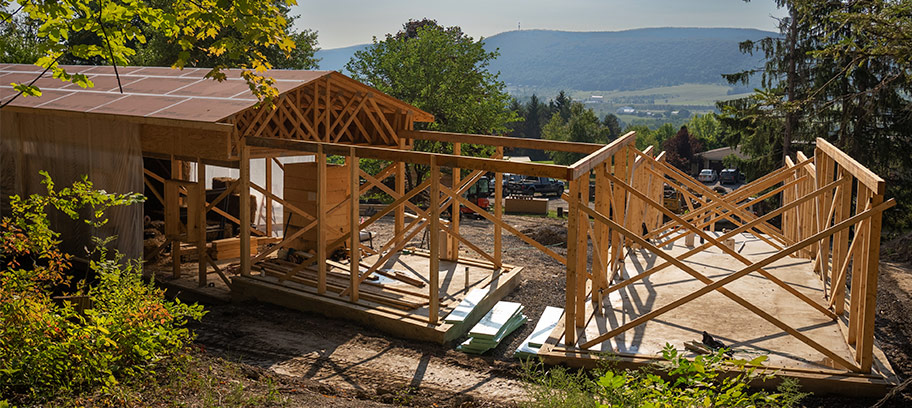
Jonesboro is a town located near the Eastern border of Arkansas, with a population of approximately 60,000. From a human standpoint, it’s not the most likely candidate for a traditional Orthodox mission, but for an Orthodox Christian who orders his priorities around Christ and His Church, it makes perfect sense. Read more...
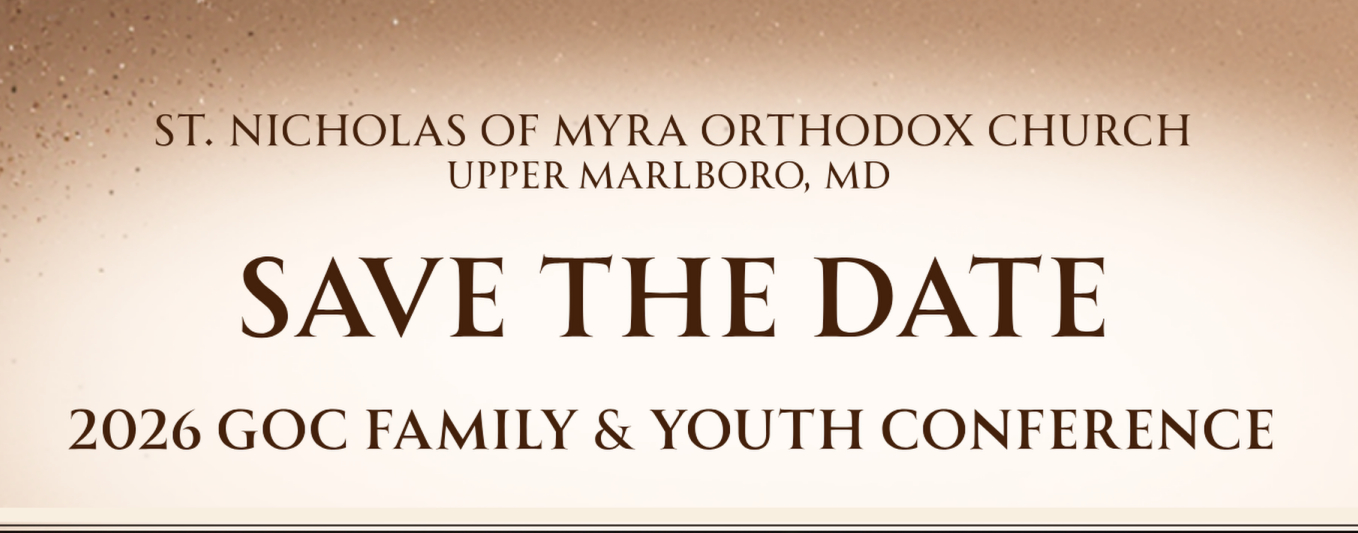
2026 Youth Conference
Please join us for the 2026 youth conference in Upper Marlboro, MD! To learn more, visit the this page.
Q. There seems to be a lot of variation in how people observe fasting, but my confessor told me to fast from oil on Wednesday and Friday. Oil is a pretty vague category, though, and I was wondering if I could get a more explicit description of what kinds of food and drink are excluded on strict fast days. Read more...
© 2026 Church of the Genuine Orthodox Christians of America (GOC). All Rights Reserved.
For inquiries, please contact the webmaster.